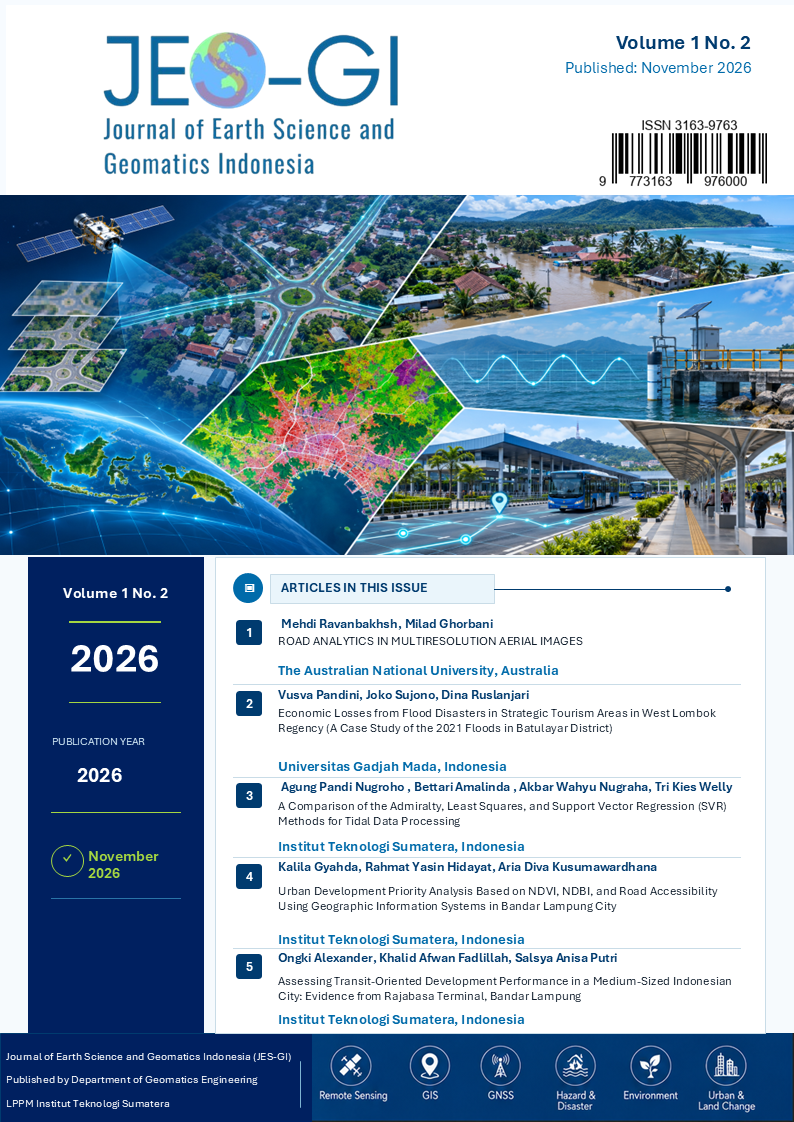
Economic Losses from Flood Disasters in Strategic Tourism Areas in West Lombok Regency (A Case Study of the 2021 Floods in Batulayar District)
Abstract
This study identifies the spatial distribution of flood-affected areas, quantifies economic losses, and formulates mitigation strategies using the ECLAC method. The findings reveal that the most severely affected areas are West Batulayar, Meninting, and Sandik, with direct losses amounting to IDR 3.223.696.500 and indirect losses totaling IDR 1.368.797.845. The proposed mitigation strategies encompass structural measures, including the rehabilitation of drainage systems, bridges, and residential structures, as well as non-structural measures through risk-based spatial planning enforcement, the integration of disaster risk reduction into the Regional Spatial Plan and the Regional Tourism Development Plan, alongside participatory approaches and cross-sectoral coordination.
Keywords: Flood; Tourism; ECLAC
Downloads
References
Becken, S., & Hughey, K. F. D. (2013). Linking tourism into emergency management structures to enhance disaster risk reduction. Tourism Management, 36, 77–85. https://doi.org/10.1016/j.tourman.2012.11.006
Berrittella, M., Bigano, A., Roson, R., & Tol, R. S. J. (2004). A general equilibrium analysis of climate change impacts on tourism. Tourism Management, 27(5), 913–924. https://doi.org/10.1016/j.tourman.2005.05.002
Biardeau, L. T., & Sahli, M. (2024). Investigating the non-linear impacts of seven types of natural disasters on inbound tourism: Insights from the EM-DAT database. Tourism Economics, 30(4), 900–923. https://doi.org/10.1177/13548166241229319
Chen, H., Xu, Z., Liu, Y., Huang, Y., & Yang, F. (2022). Urban Flood Risk Assessment Based on Dynamic Population Distribution and Fuzzy Comprehensive Evaluation. International Journal of Environmental Research and Public Health, 19(24). https://doi.org/10.3390/ijerph192416406
Dematoto Argyo. (2019). Kajian Refleksivitas Masyarakat Risiko dalam Pengembangan Pariwisata Siaga Bencana Berbasis Collaborative Governance. Talenta Conference Series: Local Wisdom, Social, and Arts (LWSA), 2(1), 1–7. https://doi.org/10.32734/lwsa.v2i1.586
Ghozali, I. (2011). Aplikasi Analisis Multivariate dengan Program IBM SPSS 19 (5th ed.). Badan Penerbitan Universitas Diponegoro.
Guo, J., Wu, X., & Wei, G. (2020). A new economic loss assessment system for urban severe rainfall and flooding disasters based on big data fusion. Environmental Research, 188. https://doi.org/10.1016/j.envres.2020.109822
ILO. (2020). ILO Sectoral Brief : The Impact of COVID-19 on the tourism sector. International Labour Organization, 2–9.
Jayantara, I. G. N. Y. (2020). IMPLEMENTASI QGIS UNTUK MENGESTIMASI KERUGIAN EKONOMI AKIBAT BANJIR DI KABUPATEN BANDUNG. Jurnal Pendidikan Teknologi Dan Kejuruan, 18(2).
Marchiavelly, M. I. C., Narieswari, L., Munajati, S. L., Sumaryono, Santoso, W. E., & Martha, S. (2012). PEMETAAN RISIKO BENCANA PADA DAERAH PARIWISATA KABUPATEN LOMBOK BARAT, NUSA TENGGARA BARAT (Hazard Risk Mapping on Tourism Region of West Lombok Regency, West Nusa Tenggara).
Marselina, M., Nurhayati, S. A., & Pandia, S. L. (2022). Flood Analysis and Estimating Economic Losses in an Affected Area (Case Study: Cikapundung Watershed). Air, Soil and Water Research, 15. https://doi.org/10.1177/11786221221131277
Pirngadi, R. S., Rahmawaty, Ayu, S. F., & Rauf, A. (2024). Estimation of loss of rice farmers due to flood at Krueng Kluet Watershed (with the eclac method approach). IOP Conference Series: Earth and Environmental Science, 1302(1). https://doi.org/10.1088/1755-1315/1302/1/012125
Rittichainuwat, B. N. (2006). Tsunami recovery: A case study of Thailand’s tourism. Cornell Hotel and Restaurant Administration Quarterly, 47(4), 390–404. https://doi.org/10.1177/0010880406289994
Salman, A. M., & Li, Y. (2018). Flood Risk Assessment, Future Trend Modeling, and Risk Communication: A Review of Ongoing Research. Natural Hazards Review, 19(3). https://doi.org/10.1061/(asce)nh.1527-6996.0000294
Tanoue, M., Taguchi, R., Nakata, S., Watanabe, S., Fujimori, S., & Hirabayashi, Y. (2020). Estimation of Direct and Indirect Economic Losses Caused by a Flood With Long-Lasting Inundation: Application to the 2011 Thailand Flood. Water Resources Research, 56(5). https://doi.org/10.1029/2019WR026092
Toubes, D. R., Araújo-Vila, N., & Fraiz-Brea, J. A. (2021). Factors influencing the assessment of tourism damage caused by river floods. Journal of Tourism and Development, 2021(36), 51–61. https://doi.org/10.34624/rtd.v1i36.8917
Wu, Z., Zheng, X., Chen, Y., Huang, S., Hu, W., & Duan, C. (2023). Urban Flood Loss Assessment and Index Insurance Compensation Estimation by Integrating Remote Sensing and Rainfall Multi-Source Data: A Case Study of the 2021 Henan Rainstorm. Sustainability (Switzerland), 15(15). https://doi.org/10.3390/su151511639
Yu, Q., Wang, Y., & Li, N. (2022). Extreme Flood Disasters: Comprehensive Impact and Assessment. Water (Switzerland), 14(8). https://doi.org/10.3390/w14081211